
Products
A SedCon® Turbo System consists of multiple Turbo Units connected to a hydraulic power source by a piping loop and riser hoses. A valve box near each Turbo Unit directs flow to the hydraulic motor and/or rotary actuator.
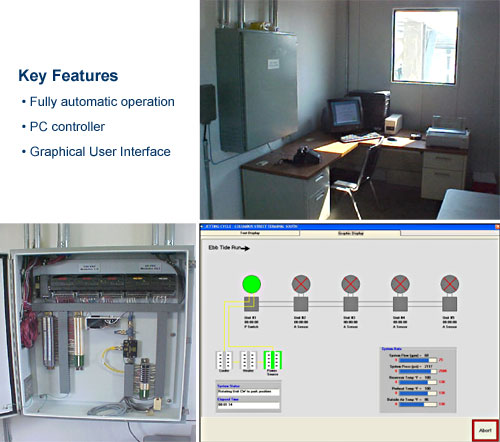
A computer controller and I/O interface operates the system, activating switches and solenoids and monitoring sensors. An inline heater and inline cooler keep the hydraulic fluid at the proper operating temperature. Hydraulic winches raise and lower the Turbo Units for maintenance.
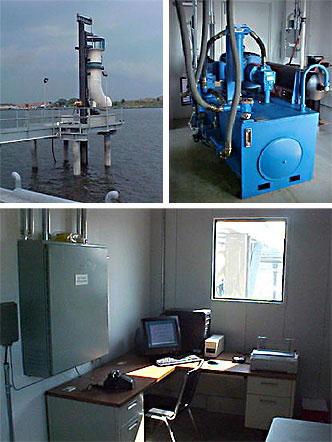
Turbo Units
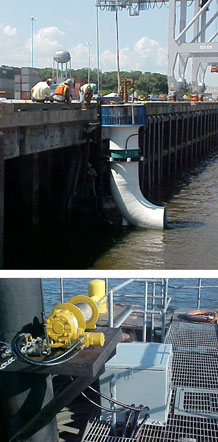
SedCon® Turbo Units are installed along the face of a dock, just above the mud bottom. During operation, a SedCon Turbo Unit draws water into a bell-mouth intake and discharges it outward across the bottom as a powerful jet. The jet discharge keeps sediment in suspension by augmenting the speed of passing tidal currents. SedCon® Turbo Units operate in sequence with the tidal cycle, producing a series of overlapping jet flow patterns that prevent sedimentation in the berthing area.
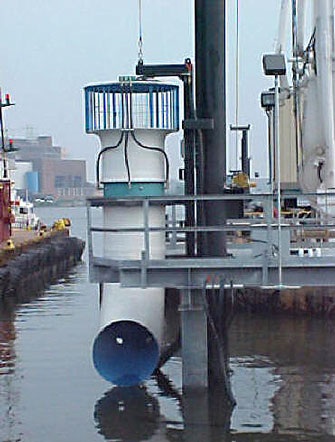
Power Source
A single electric motor-driven hydraulic pump powers the SedCon® Turbo System. The power source is connected to the Turbo Units by a header piping loop and riser hoses. The system is designed to operate using a non-toxic, environmentally-safe hydraulic fluid.
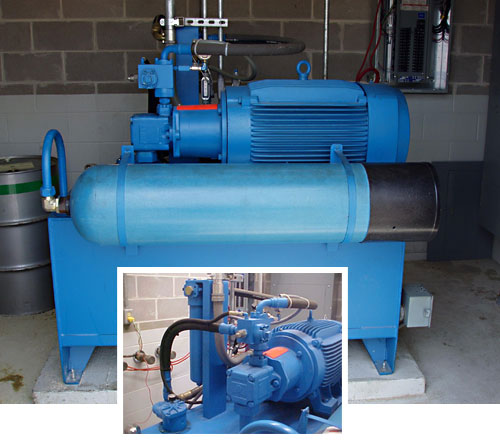
Heater & Cooler
The temperature of the hydraulic fluid must stay between 80 and 100 deg F during operation. An electric heater heats the fluid during cold weather and an electric fan-driven heat exchanger cools it during hot weather.
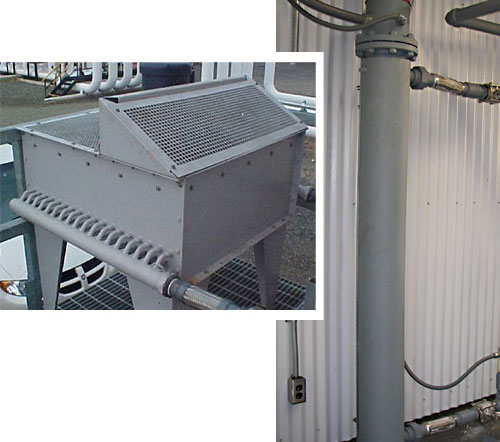
Valve Boxes
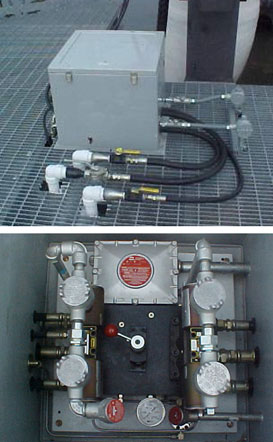
A SedCon® Turbo System uses solenoid-actuated valves to direct the hydraulic fluid flow to each Turbo Unit. Valves are housed inside a weather proof enclosure along with a rotation position sensor. Explosion proof solenoids and sensor are available as an option.
Control System
Custom-tailored software and hardware components automatically control each operational cycle. Manual control software is used for routine maintenance and inspection. During regular automatic operation, the system is coordinated with the ebb and flood tidal flows. The SedCon® Turbo Units operate in sequence, beginning at the up current end of the system. After all units have run, the system shuts down and waits for the tide to change.
Positioning System
At sites without a continuous dock face SedCon® Turbo Units are deployed from flanged guide piles. The Turbo Units have pairs of shoes that key onto the flanges, allowing them to slide up and down the guide pile.
At sites without a continuous dock face (e.g., oil terminals), the guide piles are integrated into free-standing support platforms that are interconnected by catwalks. In these cases, hydraulic-powered winches are used to raise the Turbo Units for inspection and servicing.
At sites with continuous dock structures, the guide piles are angled and integrated into the dock structure. By angling the guide pile, the Turbo Units recede behind the dock face as they are lowered into operating position. In this case, raising and lowering is typically done with a dock-based crane.
Ready to reduce dredging?
Talk with SedCon about your berth.
Share your site conditions and project goals. SedCon can help determine whether a Turbo System is a fit for your facility.