
How It Works
Our patented SedCon® Turbo System prevents shoaling in ship berths by augmenting passing tidal currents with computer-controlled underwater jets. Our system eliminates the need for maintenance dredging while maintaining full depth throughout the berthing area.
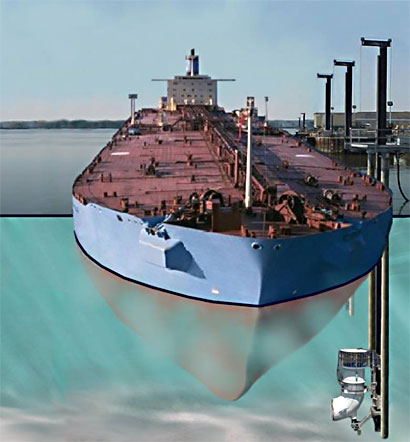
Shoaling Prevention
Estuaries have a natural depth that is maintained by passing water currents. When a berth is dredged, the current slows allowing muddy sediments to accumulate.
SedCon® Turbo Systems interrupt the shoaling process by boosting the speed of near-bottom water currents. This keeps sediment suspended and moving past the berth, not accumulating in it. The net effect is to restore the natural balance that existed in the river prior to the berth being dredged.
System Operation
Our patented SedCon® Turbo System prevents shoaling in berthing areas by boosting passing tidal currents with computer-controlled underwater jets. SedCon Systems eliminate maintenance dredging while maintaining your berth at full project depth.
A SedCon® Turbo System is composed of multiple Turbo Units mounted along the face of the dock, just above the mud bottom. The units are connected to a hydraulic power source by a system of header pipes and riser hoses. Output from the power source is directed to the Turbo Units by electrically-controlled solenoid valves. A computer operates the Turbo Units sequentially in coordination with the tides.
During operation, an impeller draws water into a Turbo Unit and forces it outward as a powerful jet. Together, the Turbo Units produce a zone of overlapping jet flows that keep sediment suspended and moving past the berthing area.
Frequently Asked Questions
What makes a site a good candidate for a SedCon® Turbo System?
Your site may be a good candidate for a SedCon® Turbo System if one or more of the following conditions exist:
- Need for full berthing depth at all times
- High dredging costs
- Difficulty in obtaining dredging permits
- Limited dredged material disposal area
- Frequent dredging events
- Significant interruption of operations due to dredging
What is a SedCon® Turbo System and how does it work?
A SedCon® Turbo System prevents sedimentation by augmenting existing water currents with underwater jets. The system includes a series of SedCon® Turbo Units mounted along the face of a dock, just above the mud bottom. During operation, a hydraulic motor-driven impeller draws water into a SedCon® Turbo Unit and forces it outward along the bottom of the berth as a powerful water jet. The jet prevents passing sediments from settling in the berthing area by keeping near bottom current velocities above the threshold for sediment deposition. A fully automated computer control system operates the SedCon® Turbo Units in sequence with the natural water flow. Each SedCon® Turbo Unit rotates up to 180 degrees, creating a series of overlapping jet flow patterns that prevent sedimentation in the entire berthing area.
Why is a SedCon® Turbo System environmentally superior to maintenance dredging?
| SedCon® Turbo System | Maintenance Dredging |
|---|---|
| Maintains a stable, undisturbed bottom habitat | Periodically destroys bottom habitat |
| Does not change water column turbidity, maintaining a stable environment for organisms living in the water column | Releases large amounts of sediment turbidity during dredging events which can adversely affect fish and fish spawn |
| Prevents the release of contaminated bottom sediments into the water column | Can release significant amounts of contaminated sediments during dredging events |
| Preserves valuable wetland space | Fills in wetland space with dredged sediments |
Does a SedCon® Turbo System shift the dredging burden onto others?
No. A SedCon® Turbo System prevents passing sediments from settling in a berthing area. The system adds no new sediment to the water column and does not erode the existing mud bottom. There has been no evidence of any increased shoaling adjacent to our existing installations.
How are SedCon® Turbo Systems viewed by the U.S. Army Corps of Engineers?
The Army Corps of Engineers is generally the lead agency in charge of reviewing and granting a permit for a SedCon® Turbo System. The Corps has been supportive of SedCon® Turbo System installations, granting permits for systems in New Jersey, North Carolina, South Carolina, Georgia, and Washington.
What permitting is required to install and operate a SedCon® Turbo System?
SedCon® Turbo Systems require the same types of State and Federal permits as other marine construction projects (e.g., a Corps of Engineers Section 404 permit).
How big are SedCon® Turbo Units and what are they made of?
We produce a range of different sized SedCon® Turbo Units. Our largest unit is 42 inches in diameter. Its overall footprint is 5-1/2 feet wide by 9 feet deep by 19 feet tall. SedCon® Turbo Units are fabricated from a variety of materials including: fiberglass, stainless steel and powder-coated carbon steel. They are designed for long-term submerged operation and utilize anti-fouling and anti-corrosion protections.
Can a SedCon® Turbo System operate when a ship is at dock?
Yes. SedCon® Turbo Units are placed behind the fender line of the berth allowing them to operate when a ship is at dock. The jet discharge from each unit is designed to pass underneath the bottom of the berthed ship, but if the jet did impinge on the side of the ship, the amount of force exerted is far less than that exerted by natural wind and water currents. The system poses no danger to a docked ship.
Can SedCon® Turbo Units be attached to an existing dock?
Yes. SedCon® Turbo Units can be attached to docks in a variety of ways. In most cases, some dock modifications are required for the installation of the SedCon® Turbo Units. The modifications can range from simply pulling a few fender piles along a full-length dock to adding pile groups and catwalks for a pier head type dock. All of this is identified during our Preliminary Study assessment.
How do I know a SedCon® Turbo System will work at my site?
SedCon Technologies, Inc. is a world leader in the design and manufacture of sedimentation control systems. We have systems that have been operating successfully at a variety of different sites since 1988. These systems have maintained water depth without the need for further dredging.
The first step we take to assess the feasibility of a system for your site is to conduct a Preliminary Study assessment. In this study we determine the physical properties of the sediments, gather information on the tides and currents, and examine the physical and structural layout of your dock. Using this information, we determine the feasibility of a SedCon® Turbo System for your site and develop a conceptual system design.
Technical Article
Click here to view a technical paper that one of our clients presented at the ASCE Ports 2007 Conference.
Ready to reduce dredging?
Talk with SedCon about your berth.
Share your site conditions and project goals. SedCon can help determine whether a Turbo System is a fit for your facility.